There is a moment in every IRONMAN race, usually somewhere around kilometer thirty of the marathon, after the swim and the bike have already drained you, when you stop lying to yourself. The crowd noise fades. The pace charts you taped to your handlebars are useless. What remains is something quieter and far more honest: did you train the system, or did you only train the story you told about training?
Endurance sport is the most accurate audit a person can submit themselves to. It does not care about your title, your speeches, or your good intentions. It only asks one question, repeatedly, for hours on end: “does the underlying system hold?”
I have been chasing the answer to that question for most of my adult life, first on the road and in the water, and eventually in classrooms, ministries, and now, in the pages of a book.

The Question That Followed Me Off the Course
Years ago, while founding the Bahrain Triathlon Federation and later the Bahrain School and Collegiate Sports Federation, I noticed something I could not stop thinking about. The athletes who succeeded long-term were almost never the most talented ones. They were the ones whose support systems were honest. Their coaches told them the truth. Their training plans were measurable. Their progress was tracked, not narrated.
The athletes who failed often had the same talent, sometimes more. What they lacked was a system that could be trusted to give them accurate feedback.
When I began my doctoral research at Claremont Graduate University, that observation refused to stay on the track. I started seeing the same pattern in classrooms, in ministries, in cities, and in entire countries. Some institutions consistently produced strong outcomes. Others, despite enormous talent and ambition, kept stalling in the same places, decade after decade.
It was tempting, and convenient, to blame culture. But the more I studied, the less that explanation held up. Cultures change. Systems are what determine whether change becomes durable.int
The Idea Behind “The Trust Trap”
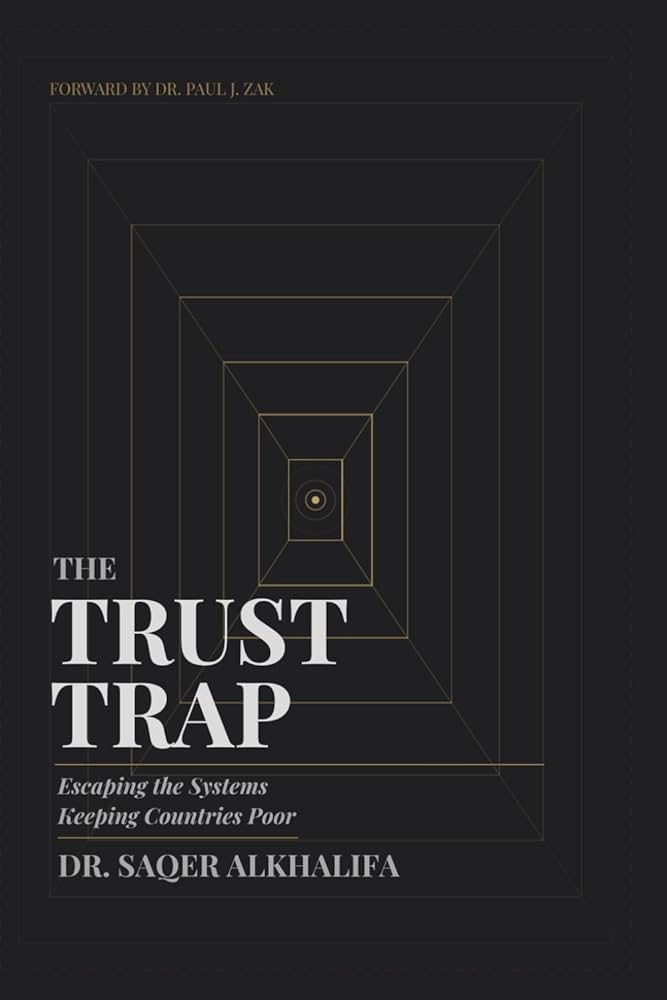
“The Trust Trap: Escaping the Systems Keeping Countries Poor” is the book I wish I had been handed at the start of this journey. It argues something simple and, I hope, useful: trust is not a cultural trait. It is a design outcome.
We tend to talk about trust as if it were the weather, something that happens to a country, a company, or a community. The book makes the opposite case. Trust is infrastructure. It is built, brick by brick, by institutions that are predictable, fair, and honest about their own performance. When that infrastructure is solid, nations thrive. When it cracks, even the most ambitious reforms become what I call “Reform Theater”, motion without movement, announcements without accountability.
Drawing on case studies from Bahrain, Japan, the United States, Rwanda, Finland, Singapore, and Estonia, the book traces how some countries have engineered trust into the architecture of their institutions, while others, often with greater wealth and more talented populations, remain stuck in cycles of disengagement.
I was honoured that Dr. Paul J. Zak, the neuroscientist who pioneered the study of trust at Claremont’s Center for Neuroeconomics Studies, agreed to write the foreword. His research first proved that trust is biological. The book extends that idea to argue that trust is also institutional, and therefore, designable.
Why This Book Matters Now, Especially Here
The Gulf is at an inflection point. We are moving fast, economically, socially, and demographically, and we are asking enormous questions of our institutions. “The Trust Trap” is not a critique of any one country. It is a toolkit for any leader, educator, athlete, founder, or citizen who has ever asked: “how do we build something that lasts?”
You will find no slogans in it. You will find frameworks, case studies, and a step-by-step process to measure and rebuild trust in any institution, from a sports federation to a sovereign state.
I wrote it for policymakers, but also for coaches. For ministers, but also for school principals. For corporate leaders, and for the parent who wonders why some schools earn loyalty across generations and others do not. If you have ever finished a race, a literal one, or the metaphorical kind we run inside our organizations, and asked yourself whether the system was telling you the truth, this book is for you.
How to Get It
“The Trust Trap” is available now on Amazon in three formats, Kindle, paperback, and hardcover.
Order here:
https://www.amazon.com/dp/B0GWVSL4CR
A free discussion guide with 49 questions, designed for book clubs, teams, and university seminars, is available at saqeralkhalifa.com, along with a free preview of Chapter 1.
If the book stays with you, I would be grateful if you left a review on Amazon. In the world of books, an honest review is the equivalent of a well-built feedback loop, it is how the system learns whether the work is doing what it set out to do.
The finish line is just the beginning of the next conversation. I hope this book starts one with you.